
Best Shopify Order Tracking Apps (2026)

Last updated: April 2026 · Ratings, install counts, and pricing verified from live Shopify App Store listings on April 22, 2026.
Key Takeaways
- Order tracking apps solve four jobs — branded tracking pages (reduce WISMO support tickets), shipment notifications (email/SMS to keep customers informed), dropshipping-friendly tracking (carrier masking, origin hiding, Chinese carrier translation), and post-purchase AOV (upsells embedded in tracking pages and notification emails). The right app depends on which job matters most for your store.
- ParcelWILL (formerly Parcel Panel) leads the category with a 5.0-star rating across 2,426 reviews and 68,000+ active installs — the most battle-tested branded tracking app on the Shopify App Store in 2026.
- AfterShip is the enterprise default at 4.5 stars across 1,220 reviews — the widest carrier network (500+) and deepest integrations, though pricier at scale and slower to set up than newer alternatives.
- 17TRACK offers the widest global carrier coverage with 2,000+ carriers across 220+ countries and a 4.9-star rating — the go-to pick for international and cross-border stores.
- Shopify's native order status page is free, works for basic needs, and is genuinely enough for stores under 50 orders/month — install a dedicated app only once support tickets about "Where is my order?" start consuming real time.
- Tracking-page upsells (Rush, Ordertracker) can add 2-5% AOV lift on stores with high repeat-purchase potential — the post-delivery moment is when customer excitement peaks and upsell conversion is highest.
The Four Jobs of Shopify Order Tracking Apps
Most Shopify order tracking roundups list 10 apps that all do roughly the same thing — show a shipment status page and send a delivery email — and rank them by star rating. That framing misses the point. Order tracking apps actually solve four distinct jobs, and the right app depends on which ones matter most for your store economics.
The first job is branded tracking pages. When customers click "Track my order" from their confirmation email, they should land on your store, not a third-party page that looks like a generic logistics portal. A branded tracking page displays order status with your logo, colors, product images, and navigation back into your catalog — turning a passive waiting moment into a second brand impression. The direct business value is WISMO reduction: "Where Is My Order?" tickets typically account for 20-40% of ecommerce support volume, and a visible branded tracking page catches most of those inquiries before they become tickets.
The second job is shipment notifications. Proactive email and SMS updates at key milestones — order confirmed, shipped, out for delivery, delivered, delivery exception — instead of customers checking tracking pages themselves. Done well, proactive notifications preempt WISMO entirely: the customer is told their package is out for delivery before they think to ask. Done poorly (delayed notifications, missing milestones), they create more support tickets than no notifications at all. SMS-enabled apps lift open rates from email's ~20% to SMS's ~95%, and are worth the incremental cost for direct-to-consumer brands with time-sensitive products.
The third job is dropshipping-friendly tracking. Dropshippers face a specific problem: orders ship from Chinese suppliers with carriers like YunExpress, 4PX, Cainiao, or SF Express, and the raw tracking data reveals origin addresses, Chinese carrier names, and Chinese-language status events that break the illusion of a US or EU brand. Dropshipping-focused tracking apps translate Chinese carrier names to clean generic phrases, hide origin addresses, mask carrier identity, and replace raw tracking events with brand-safe language. This is a different feature set than mainstream branded tracking.
The fourth job is post-purchase AOV on the tracking page. Tracking pages are one of the most-visited post-purchase surfaces — customers check their tracking pages an average of 3-5 times between order and delivery. That is 3-5 free brand impressions and 3-5 opportunities to show complementary product recommendations, social proof, or time-limited offers. Apps like Rush and Ordertracker build upsell mechanics directly into the tracking page, turning a support-cost-reduction tool into a revenue-generating asset.
This post ranks 8 options across all four jobs with verified April 2026 ratings and pricing, and explains which app profile fits which store.
Order tracking stacks with other post-purchase tools. See our guides on best Shopify shipping apps for the label-printing and multi-carrier fulfillment layer that sits upstream of tracking, best Shopify digital product apps for delivery workflows on digital orders that do not need carrier tracking, and best Shopify dropshipping apps for the broader dropshipping tool stack that pairs with carrier-masking tracking apps.
Quick Comparison: 8 Best Shopify Order Tracking Apps (2026)
| App | Rating | Free Plan | Paid From | Carriers | Best For |
|---|---|---|---|---|---|
| ParcelWILL (Parcel Panel) | ⭐ 5.0 (2,426) | Yes | $9/mo | 1,581 | Most battle-tested branded tracking, 68K+ installs |
| PluginHive Shipment Tracking & Notify | ⭐ 4.9 | Yes | $9/mo | Hundreds of global carriers | Affordable tracking with automated shipment notifications |
| AfterShip Order Tracking | ⭐ 4.5 (1,220) | Free to install | $11/mo | 500+ | Enterprise stores, deepest carrier integrations |
| 17TRACK Order Tracking | ⭐ 4.9 (3,200+) | Yes (100-200 orders) | $9/mo | 2,000+ | International stores, 220+ countries coverage |
| Tracktor (ShopPad) | ⭐ 4.8+ | Yes (25 orders) | $9.99/mo | 1,700+ | Established option, Shopify Flow integration |
| Rush — Order Tracking & EDD | ⭐ 4.8+ | Free to install | $29/mo | 1,700+ | Tracking-page upsells, AI delivery predictions |
| Ordertracker — Track & Upsell | ⭐ 4.8+ | Yes | From $9.99/mo | 1,200+ | Dropshipping (Chinese carrier masking + upsells) |
| Synctrack AI Order Tracking | ⭐ 4.9 (75) | Yes | Custom | 900+ | AI analytics, newer Built for Shopify entrant |
| Shopify Order Status (native) | — | Included | Free | Supported Shopify carriers | New stores under 50 orders/month, simple setup |
Job 1: Branded Tracking Pages (The Core Category)
This is the main category — a customer-facing tracking page on your domain with your branding, reducing "Where is my order?" support volume. Pick one. Running two tracking apps simultaneously creates conflicting notification emails and confuses customers about where to check status.
1. ParcelWILL (formerly Parcel Panel)
Best for: Shopify stores of any size that want the most battle-tested branded tracking app with the largest install base, cleanest setup, and a genuinely generous free plan.
ParcelWILL holds a 5.0-star rating across 2,426 reviews and is installed on 68,000+ Shopify stores as of April 2026, with Built for Shopify certification. The rebranding from Parcel Panel to ParcelWILL happened in 2025 under the same developer (CWILL) — the product is mature, not newly launched. The 5.0 rating across that review volume is the strongest social proof in the tracking category on Shopify.
The feature set covers the full tracking job: branded tracking pages that automatically match your store theme, 1,581 global carriers integrated, automated email notifications at seven milestone triggers, a centralized dashboard showing all shipments with filters by status/carrier/transit time, shipment exception alerts (when a package is delayed or misrouted you see it before the customer does), a "Track My Order" lookup page customers access by order number + email, and product recommendations embedded in tracking pages for modest AOV lift.
Merchant reviews consistently cite two advantages over AfterShip specifically: easier setup ("install automatically syncs with Shopify") and more generous free tier. Merchants moving from AfterShip report cleaner UI, faster sync, and support response times within hours instead of days. The 24/7 multilingual support team (Cecilia, Donna, Jael are specific names that appear frequently in positive reviews) is a real operational advantage for stores outside US business hours.
Where it falls short: free tier quota fills quickly for high-volume stores — once you blow past the included monthly order count, overage charges can stack up unexpectedly. Merchants complain when they discover this retroactively. Fewer enterprise integrations than AfterShip (no deep Oracle, SAP, or Salesforce hooks). For Shopify-native stores these gaps do not matter; for enterprise retail with complex ERP stacks, AfterShip is still the safer pick.
Pricing: Free plan available. Paid plans from $9/mo based on monthly order volume.
2. PluginHive Shipment Tracking & Notify
Best for: Shopify merchants looking for an affordable order tracking solution with automated shipment notifications, branded tracking pages, and support for major global carriers.
PluginHive Shipment Tracking & Notify helps Shopify merchants deliver a seamless post-purchase experience through real-time order tracking, automated delivery notifications, and customer self-service tracking. The app is designed to reduce WISMO ("Where Is My Order?") support requests by proactively keeping customers informed at every stage of the shipping journey.
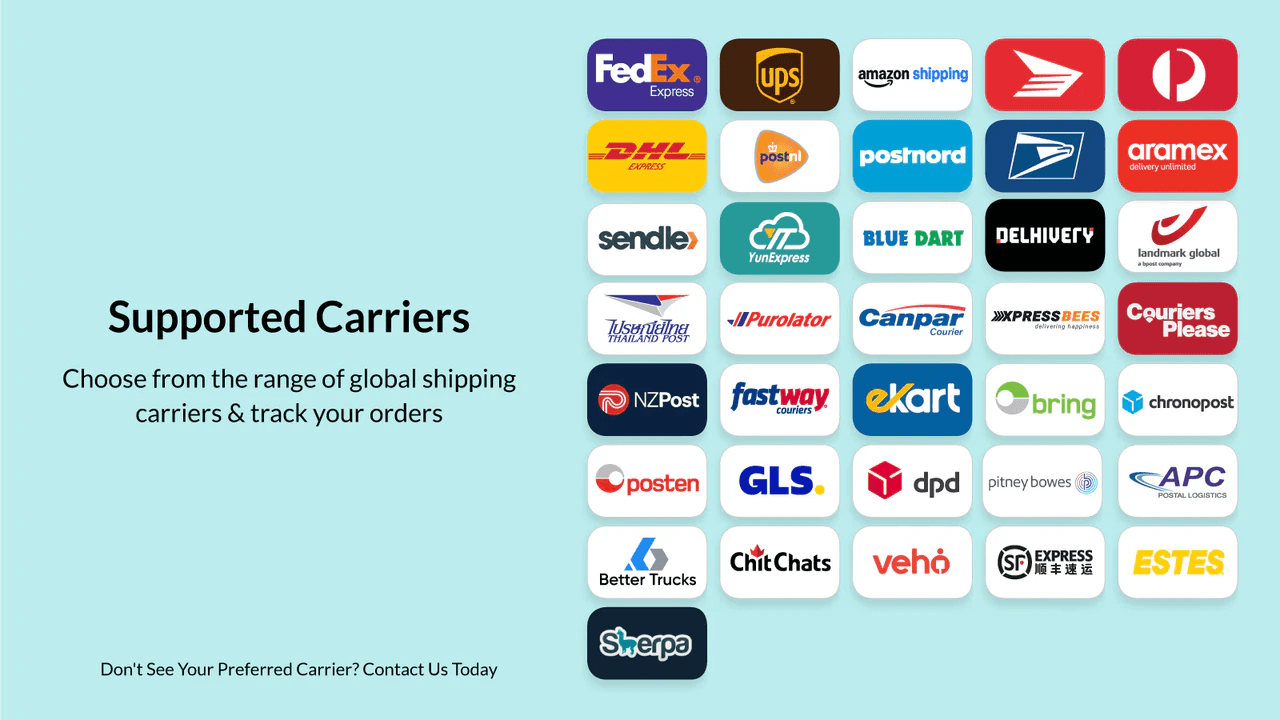
One of the app's biggest strengths is its extensive carrier support. Merchants can track shipments from leading carriers such as UPS, FedEx, USPS, DHL Express, Canada Post, Australia Post, Royal Mail, Aramex, Blue Dart, Delhivery, and hundreds of other global and regional carriers from a single platform. Tracking information is automatically synchronized and updated, ensuring customers always have access to accurate shipment status updates.
The feature set includes branded tracking pages, customizable shipment notification emails, automated tracking updates, delivery status alerts, and centralized shipment visibility. Customers can track their orders directly from tracking emails, reducing support tickets while improving trust and transparency.
Unlike many tracking-focused apps that primarily emphasize marketing automation, the PluginHive Shipment Tracking App focuses on shipping visibility and operational efficiency. It integrates seamlessly with Shopify fulfillment workflows and PluginHive's shipping automation solutions, allowing merchants to manage shipping, tracking, and customer communication from a unified ecosystem.
For merchants handling growing order volumes, the app helps streamline post-purchase operations, improve delivery communication, and enhance customer satisfaction without adding unnecessary complexity. This makes it particularly attractive for small and mid-sized businesses that need reliable shipment tracking without enterprise-level costs.
Where it stands out: support for major global carriers, automated shipment tracking notifications, branded customer tracking pages, real-time package tracking, delivery visibility, WISMO reduction, and seamless integration with Shopify shipping workflows.
Pricing: Paid plans start at $9/month (Starter), $29/month (Growth), and $49/month (Advanced), with a 14-day free trial available on all paid plans.
3. AfterShip Order Tracking
Best for: enterprise Shopify Plus stores, high-volume merchants, and brands that need the deepest integration ecosystem (Klaviyo, Gorgias, Shopify Flow, Oracle, SAP) alongside 500+ carrier coverage.
AfterShip holds 4.5 stars across 1,220 reviews and is Built for Shopify certified — the long-established category leader before ParcelWILL overtook it on star rating and install growth. The 4.5 rating versus ParcelWILL's 5.0 reflects a real gap: merchants report more setup friction, slower support response times during peak seasons, and pricing that scales aggressively past the free-to-install entry point.
What AfterShip still wins on is ecosystem. The integration list runs to dozens of enterprise platforms (Klaviyo for email flows, Gorgias for support desks, Shopify Flow for custom automation, Zendesk, Salesforce Service Cloud, Oracle CX, SAP Commerce Cloud), the API is well-documented, and carrier relationships are the deepest in the category — if your store ships with an obscure regional carrier in Southeast Asia or Latin America, AfterShip is more likely to have native integration than any alternative. For Shopify Plus merchants running enterprise tech stacks, these integrations matter more than a UI polish difference.
The feature set includes: branded tracking pages with drag-and-drop editor, seven different notification triggers with flexible email editor, automated tracking link injection on confirmation emails and order history, an auto-generated tracking URL that replaces the shipper's URL (improving your domain SEO), review request integration at delivery, and a dashboard with detailed delivery analytics.
Where it falls short: pricing is free-to-install but scales fast. Paid plans start at $11/mo and climb meaningfully for mid-volume stores. UI feels dated compared to ParcelWILL. Support response during peak season (Black Friday, December holiday) is slower than competitors. Newer stores consistently report choosing ParcelWILL over AfterShip and being happier, unless they need enterprise-specific integrations.
Pricing: Free to install. Paid plans from $11/mo, 7-day free trial.
4. 17TRACK Order Tracking
Best for: international and cross-border Shopify stores that ship globally and need the widest carrier coverage — 2,000+ carriers across 220+ countries with native multilingual tracking.
17TRACK holds a 4.9-star rating across 3,200+ reviews — the highest review volume in the tracking category. The app is powered by the 17TRACK global tracking platform, one of the largest package tracking networks in the world, which processes billions of parcels annually outside of Shopify specifically. This platform scale translates to Shopify as genuinely global coverage — if you ship to a country and carrier that exists, 17TRACK almost certainly tracks it.
Core features: tracking for 2,000+ carriers across 220+ countries, native multilingual tracking pages (Chinese Simplified/Traditional, Dutch, English, French, German, Italian, Portuguese, Spanish, Swedish), branded tracking page with customizable layout, automated email and SMS notifications, AI-powered product recommendations on tracking pages, buyer protection program (optional customer-facing insurance against loss/damage/delay), detailed delivery analytics with transit-time breakdowns by carrier and destination, and carrier masking for stores that do not want to expose shipping partner identity.
The multilingual feature matters specifically for international stores. If 40% of your customers are in non-English-speaking markets and AfterShip/ParcelWILL show them English-only tracking pages, you are creating friction that 17TRACK eliminates. Cross-border stores in European markets (Germany, France, Italy, Netherlands, Sweden) specifically benefit.
Where it falls short: free plan caps at 100-200 shipments depending on source — Essentials tier at $9/mo unlocks up to 500, Pro at $28/mo covers up to 1,000, Business at $48/mo covers up to 2,000. Overages can be abrupt for stores in the 200-500 order range that do not upgrade in time. UI is less polished than ParcelWILL's. Some merchants report occasional delays between carrier data refresh and customer-facing status — the tradeoff for such wide carrier coverage.
Pricing: Free plan (100-200 orders). Essentials $9/mo. Pro $28/mo. Business $48/mo.
Job 2: Notifications + Customization (Established Shopify-Native Options)
5. Tracktor Order Tracking (by ShopPad)
Best for: established Shopify stores that want deep customization of tracking UX including 3D interactive maps, Shopify Flow integration, and flexible custom tracking statuses beyond the standard milestones.
Tracktor (built by ShopPad) is one of the longer-established tracking apps on Shopify, with 1,700+ global carriers integrated and a feature set that emphasizes UX flexibility over the branded-page simplicity of ParcelWILL. The differentiating features: a 3D interactive map showing package location globally (the visual is memorable for customers — more engaging than a static status bar), custom tracking status text (merchants rewrite milestone language to match brand voice), native Shopify Flow integration (trigger custom workflows on tracking events — send a VIP customer a gift when their package is out for delivery), and extensive carrier-branding removal for stores that do not want shipper identity exposed.
Pricing starts at $4.99/mo on the lowest paid tier or free for 25 orders/month, making it one of the most accessible paid options on this list for small-to-mid stores. For merchants who value control over default elegance, Tracktor offers more customization surface than ParcelWILL's out-of-the-box design.
Where it falls short: setup complexity is higher than ParcelWILL or 17TRACK — non-technical merchants report taking several hours to configure properly. Some merchant reviews flag occasional bugs with the 3D map feature on specific carriers or edge cases. Higher pricing on enterprise tiers relative to feature parity with ParcelWILL. Branding removal is locked to paid plans only (the free plan shows Tracktor branding on your tracking page, which may be acceptable at 25 orders/month but not at scale).
Pricing: Free up to 25 orders/mo. Paid from $4.99-$9.99/mo depending on features. 14-day free trial.
6. Synctrack AI Order Tracking
Best for: merchants who want AI-driven delivery analytics and a newer Built for Shopify entrant with a generous free plan and modern UI.
Synctrack AI is a newer entrant in the tracking category with 4.9 stars across 75 reviews and Built for Shopify certification. The app positions specifically on AI analytics — predictive delivery dates, transit-time forecasting, and exception prediction before a package becomes actively late. For stores where delivery timing materially affects customer satisfaction (gifts, time-sensitive products), the predictive angle has value.
Core features overlap the mainstream branded-tracking set (branded page, notifications, carrier integration) plus the AI layer. For stores evaluating new apps versus established players, Synctrack is worth a look on the strength of the Built for Shopify badge and the strong early review score — though the 75-review base is much smaller than ParcelWILL's 2,426 or 17TRACK's 3,200+, which means less historical stress-testing at peak volume.
Where it falls short: small review base is the main caveat. Pricing is custom-quoted rather than listed on the App Store, which makes initial evaluation harder. Newer carrier integration list (approximately 900 vs ParcelWILL's 1,581 or 17TRACK's 2,000+) — if you ship with an obscure regional carrier, verify coverage before committing.
Pricing: Free plan available. Paid tiers custom-quoted.
Job 3: Dropshipping-Friendly Tracking (Carrier Masking + Chinese Translation)
7. Ordertracker — Track & Upsell
Best for: dropshipping stores sourcing from Chinese suppliers that need to mask carrier names, hide origin addresses, and translate Chinese tracking events into clean generic English.
Ordertracker is built specifically for the dropshipping use case that mainstream tracking apps handle awkwardly. When an order ships from a Chinese supplier via YunExpress, 4PX, Cainiao, SF Express, or China EMS, the raw tracking data reveals the origin address (usually somewhere in Guangdong province), the Chinese carrier name, and status events in mixed Chinese and English. For a US or EU brand marketing itself as premium, exposing all of this breaks customer trust and triggers refund requests.
Ordertracker's differentiating features: automatic translation of Chinese carrier names to generic English phrases ("In Transit" instead of "China Post, Guangzhou sorting facility departed"), origin address hiding (customer never sees the Chinese origin), carrier masking (carrier name replaced with your brand name or generic "Shipping Partner"), and clean generic status phrasing that matches brand voice. All of this happens automatically without merchant intervention on each shipment. Built-in upsells on the tracking page add a secondary revenue angle (see Job 4 below).
Where it falls short: the dropshipping-specific features are overkill for non-dropshippers — a US brand shipping domestically via UPS does not need Chinese carrier translation. Smaller carrier integration count (1,200+) than 17TRACK or ParcelWILL, though the coverage is heavily weighted toward dropshipping-relevant carriers. Less polished UI than ParcelWILL.
Pricing: Free plan available. Paid tiers from approximately $9.99/mo based on volume and features.
Job 4: Tracking-Page Upsells (Post-Purchase AOV)
8. Rush — Order Tracking & EDD
Best for: repeat-purchase brands that want to treat the tracking page as a revenue surface — AI delivery predictions on product pages, upsell mechanics on tracking pages, and deep Klaviyo/Omnisend integration for post-purchase email flows.
Rush is the tracking app built explicitly around post-purchase AOV rather than pure WISMO reduction. The app's positioning: customers check their tracking pages 3-5 times between order and delivery, and those 3-5 free brand impressions should generate revenue, not just display status. The feature set reflects that angle: customizable "Track My Order" pages with product recommendation widgets, AI-predicted estimated delivery dates (EDD) shown on product detail pages before purchase (proven to lift conversion rates), automated SMS and email shipping notifications with embedded product promotions, deep integration with Klaviyo, Yotpo SMSBump, Loox, Postscript, and Omnisend for post-purchase email flows, carrier masking and origin hiding for dropshippers, and detailed analytics on tracking-page engagement and upsell conversion.
Real-world economics: a store with 1,000 orders per month where 3% of tracking-page visitors accept an upsell offer, at average $25 upsell value, generates $750/month in incremental revenue from the tracking page alone — well above the subscription cost. Repeat-purchase brands in categories like beauty, supplements, food, and apparel see the strongest tracking-page upsell conversion because the complementary products are naturally obvious to customers already bought-in to the brand.
Where it falls short: starts at $29/mo which is the highest entry point on this list — not cost-effective for stores under 500 orders/month because upsell volume is too low to recover the subscription. Setup is more involved than pure-tracking apps due to the upsell mechanic configuration. Overkill for one-time-purchase categories (high-ticket furniture, appliances) where repeat purchases are naturally rare.
Pricing: Free to install. Paid plans from $29/mo. 10-day free trial.
A Note on Shopify's Native Order Status Page
9. Shopify Order Status (Native)
Best for: new Shopify stores under 50 orders per month shipping with Shopify's supported carriers, where WISMO support volume has not yet grown into a real cost.
Shopify's built-in order status page is free and automatically generated when you fulfill orders and add tracking numbers. Customers can check updates from the order status page link, shipping confirmation emails, the Shop app, or by entering their order confirmation number and verifying their email or phone. For US-based stores shipping with Shopify's supported carriers (USPS, UPS, FedEx, DHL, Canada Post, Royal Mail), this covers the basics — real-time tracking, live carrier map, customizable status page, and translation support.
For stores genuinely doing under 50 orders per month, this is enough. Installing a paid tracking app at that volume is premature optimization — the WISMO support ticket volume has not grown large enough to justify the subscription cost. Wait until "Where is my order?" questions become a recurring support pattern before upgrading.
Where it falls short: no branded tracking page beyond basic customization (the page lives on checkout.shopify.com domain, not yours). No automated SMS notifications. Limited exception alerting — you find out a package is delayed when the customer emails you. No upsell mechanics. No analytics on tracking-page engagement. Most stores outgrow native order status within their first 100 orders, but for the first 50 it is genuinely fine.
Pricing: Included with Shopify subscription. No additional cost.
Which App to Choose
For new stores under 50 orders/month: Shopify Order Status (native). Already included, works for basic needs, upgrade when WISMO tickets start consuming real support time.
For general-purpose branded tracking with the most battle-tested track record: ParcelWILL. 5.0/2,426, Built for Shopify, 68,000+ installs, free plan, $9/mo paid — the default pick for most Shopify stores in 2026.
For affordable tracking with automated shipment notifications and broad carrier support: PluginHive Shipment Tracking & Notify. 4.9 stars, $9/mo, branded pages and global carrier coverage for small and mid-sized stores.
For enterprise Shopify Plus merchants needing deep integrations (Klaviyo, Gorgias, Oracle, SAP): AfterShip. 4.5/1,220, free-to-install, $11/mo paid, deepest ecosystem integrations.
For international and cross-border stores shipping globally: 17TRACK. 4.9/3,200+, 2,000+ carriers across 220+ countries, native multilingual tracking, $9/mo Essentials.
For established stores wanting 3D map visualization and Shopify Flow integration: Tracktor. $4.99-9.99/mo, 1,700+ carriers, custom tracking statuses.
For dropshippers sourcing from Chinese suppliers: Ordertracker. Chinese carrier translation, origin hiding, carrier masking, and tracking-page upsells in one app.
For repeat-purchase brands treating tracking pages as revenue surfaces: Rush — Order Tracking & EDD. $29/mo, AI delivery predictions, upsell mechanics, deep Klaviyo/Omnisend integration.
For newer Built for Shopify entrants with AI analytics: Synctrack AI. 4.9/75, free plan, modern UI — worth evaluating against established players.
For most Shopify stores doing $10K-100K/month in revenue, the honest recommendation is singular: ParcelWILL. The 5.0 rating across 2,426 reviews, 68,000+ installs, Built for Shopify badge, generous free plan, and cleaner setup than AfterShip make it the lowest-risk pick that covers branded tracking, notifications, and modest upsell mechanics in one subscription. Enterprise stores with specific ecosystem needs use AfterShip. International stores use 17TRACK. Dropshippers use Ordertracker. Repeat-purchase brands willing to pay more for upsell mechanics use Rush. Everyone else defaults to ParcelWILL.
How We Ranked These Apps
This ranking is based on four criteria applied to every Shopify order tracking app tested in 2026. First, Shopify App Store rating and verified review volume as of April 22, 2026 — the signal of long-term merchant satisfaction at scale. Second, verified install counts from StoreLeads where available — install count is a stronger signal than review count for separating actively-used apps from apps with legacy review volume but declining adoption. Third, which of the four tracking jobs the app solves best (branded pages, notifications, dropshipping-friendly, tracking-page upsells) rather than a generic feature checklist. Fourth, pricing structure and total cost at realistic merchant volumes — a $9/mo entry tier is different than $29/mo entry tier, and the math differs per store profile.
Every pricing figure in this post was verified directly from the live Shopify App Store listing on April 22, 2026. App pricing structures change — always confirm current pricing on the official listing before installing. Ratings and review counts reflect the Shopify App Store at the time of our last update.
Frequently Asked Questions
What is a Shopify order tracking app?
A Shopify order tracking app provides a branded tracking page on your store domain where customers check shipment status, plus automated email and SMS notifications that proactively update customers at delivery milestones. Core features include carrier integration (tracking updates pull automatically from shipping partners), status normalization (raw carrier data translated into customer-friendly language), exception alerting (merchants notified when packages are delayed before customers complain), and analytics on delivery performance by carrier and destination.
What is the best Shopify order tracking app in 2026?
ParcelWILL (formerly Parcel Panel) leads the category with a 5.0-star rating across 2,426 reviews and 68,000+ active installs as of April 2026 — the default pick for most Shopify stores. AfterShip is the enterprise alternative at 4.5/1,220 for merchants needing deep integrations with Klaviyo, Gorgias, or enterprise platforms. 17TRACK leads on international carrier coverage with 2,000+ carriers across 220+ countries. Rush leads on tracking-page upsell mechanics. Each solves a slightly different sub-job within the category.
Does Shopify have a built-in order tracking feature?
Yes. Shopify's native order status page is automatically generated when you fulfill orders and add tracking numbers. Customers can check updates via the order status link in shipping confirmation emails, the Shop app, or by entering their order confirmation number on your store. For stores under 50 orders per month with simple shipping needs, the native page is genuinely sufficient. Stores outgrow it once "Where is my order?" support tickets become a recurring pattern or once branding consistency on the tracking page becomes a priority.
How much does a Shopify order tracking app cost?
Entry tiers range from free (ParcelWILL free plan, 17TRACK free up to 100-200 orders, Tracktor free up to 25 orders, Shopify native included) to $9-11/mo (ParcelWILL paid, AfterShip Essentials, 17TRACK Essentials, Tracktor Basic) to $29/mo (Rush Professional) for tracking-page-upsell-focused apps. Enterprise tiers scale to $100-300/mo for high-volume stores on AfterShip or 17TRACK Business. A typical mid-volume Shopify store on ParcelWILL pays approximately $19-49/mo depending on order volume.
What is WISMO and how do tracking apps reduce it?
WISMO stands for "Where Is My Order?" — the most common post-purchase support ticket category across ecommerce. WISMO tickets typically account for 20-40% of total ecommerce support volume. Tracking apps reduce WISMO in two ways: a visible branded tracking page that customers find easily (linked from confirmation email, order history, site navigation) catches inquiries before they become tickets, and proactive email/SMS notifications at shipping milestones preempt the "where is my order?" question by telling customers the answer before they ask. Stores typically see 30-50% WISMO reduction within the first 30 days of installing a branded tracking app.
Do tracking apps work with dropshipping?
Yes, but with a caveat. General-purpose tracking apps (ParcelWILL, AfterShip, 17TRACK) expose the raw carrier data — which for dropshipping means Chinese carrier names (YunExpress, 4PX, Cainiao), origin addresses in China, and status events in mixed Chinese/English. This breaks the illusion of a US or EU brand. Dropshipping-specific apps (Ordertracker, Rush's dropshipper package) translate Chinese carrier names to clean generic English, hide origin addresses, and mask carrier identity. Dropshippers should use a dropshipping-friendly app rather than a general-purpose one.
Can tracking pages drive additional revenue?
Yes. Customers typically check their tracking page 3-5 times between order and delivery, creating 3-5 free brand impressions on a high-intent post-purchase surface. Apps like Rush and Ordertracker embed product recommendation widgets, time-limited upsell offers, and social proof (review prompts) directly in the tracking page. Repeat-purchase categories (beauty, supplements, food, apparel) see 2-5% AOV lift from tracking-page upsells because complementary products are naturally obvious to customers already bought-in to the brand. One-time-purchase categories (furniture, high-ticket electronics) see much lower lift — the tracking-page-upsell pattern only makes economic sense for repeat-purchase brands.
What is the difference between ParcelWILL and AfterShip?
ParcelWILL holds 5.0/2,426 vs AfterShip's 4.5/1,220 — a meaningful gap in merchant satisfaction driven by setup simplicity and support response speed. ParcelWILL wins for most Shopify-native stores under enterprise scale. AfterShip wins on ecosystem depth: 500+ carriers (AfterShip's specialty over ParcelWILL's 1,581 includes more US enterprise carriers), deeper integrations with Klaviyo, Gorgias, Shopify Flow, Oracle, SAP, Salesforce. Shopify Plus stores on enterprise tech stacks typically stick with AfterShip. Non-Plus stores typically prefer ParcelWILL.
Do I need SMS notifications for order tracking?
Depends on your product category. SMS open rates (~95%) are dramatically higher than email (~20%), which matters for time-sensitive notifications like "out for delivery" and "delivered" where customers want immediate awareness. For direct-to-consumer brands with time-sensitive products (food delivery, gifts, anything weather-sensitive), SMS is worth the incremental cost. For stores with less time-sensitive products (home goods, apparel, general ecommerce), email-only notifications cover the critical use case and SMS is a nice-to-have rather than a must-have. Most tracking apps (ParcelWILL, AfterShip, 17TRACK, Rush) support SMS on paid tiers.
Will tracking apps slow down my Shopify store?
Apps with the Built for Shopify badge — including ParcelWILL, AfterShip, 17TRACK, and Synctrack AI — load widgets asynchronously with no impact on Core Web Vitals or Lighthouse scores. The tracking page itself is a dedicated page separate from the storefront, so storefront performance is unaffected. The only load impact is on the tracking page itself where image-heavy upsell widgets (in Rush or Ordertracker) can slow initial render if overloaded with product recommendations. Keep tracking-page upsell widgets to 2-4 recommendations maximum for clean performance.
Think Your App Belongs on This List?
We update these lists as new tools launch and existing ones improve. If you are a developer building a Shopify order tracking app and want your app considered for inclusion, submit it here — tell us what your app does, who it is for, and include a link to your Shopify App Store listing. We review every submission.