
Best Shopify Shipping Apps (2026)
Last updated: April 2026 · Pricing and ratings verified from live Shopify App Store and vendor listings on April 22, 2026. Reviewed by the Libautech team, builders of Libautech Announcement Bar — a Built for Shopify app that runs progressive and static free-shipping bars on the storefront, the merchandising layer most shipping roundups forget. Used by 5,000+ merchants across 50+ countries.
Key Takeaways
- Shipping on Shopify breaks into four jobs — label printing + multi-carrier fulfillment (backend), checkout rate calculation (rules engine), specialized delivery models (local pickup, cross-border DDP), and free-shipping merchandising on the storefront. Most roundups only cover the first job and skip the others entirely.
- Shippo is the best general-purpose label-printing and multi-carrier app at 4.8 stars across 825+ reviews, with API access on all plans and transparent per-volume pricing from $19/mo Pro.
- Shopify Shipping (the native option, included with your Shopify subscription) gets USPS/FedEx/UPS/DHL discounts up to 88% for US merchants — enough for low-volume stores but outgrown quickly once you add marketplaces or need automation rules.
- ShipperHQ ($75/mo) is the specialist checkout-rules app for complex catalogs with dimensional packing, multiple fulfillment locations, LTL freight, or in-store pickup — not the right pick for simple label printing.
- Zapiet owns the local-pickup-and-delivery category with 4.8 stars across 1,290+ reviews — the purpose-built app for hybrid stores running in-store pickup alongside shipped orders.
- Libautech Announcement Bar covers the missing merchandising layer — progressive free-shipping bars ("Add $12 more to unlock free shipping") and static threshold messaging ("Free shipping on orders over $50") that drive AOV toward your free-shipping break-even before the customer ever reaches checkout.
The Four Jobs of Shopify Shipping Apps
Most Shopify shipping roundups list 10 apps that all do roughly the same thing — print labels and compare carrier rates — and rank them by star rating. That framing misses what is actually happening on the checkout page and the storefront. Shipping on Shopify breaks into four distinct jobs, and the right app (or stack) depends on which ones you actually need solved.
The first job is label printing and multi-carrier fulfillment. The backend workflow every store does: orders come in, labels need to print, packages need to ship. The core feature set is multi-carrier rate comparison (USPS, UPS, FedEx, DHL), batch label printing, pre-negotiated carrier discounts, customs forms for international shipments, and multi-channel order consolidation (pulling orders from Shopify plus Amazon plus Etsy into one dashboard). This is where Shippo, ShipStation, ShippingEasy, and Shopify Shipping itself live.
The second job is checkout rate calculation. What rates show up at checkout, for which cart contents, with which conditions. Simple stores charge flat-rate shipping. Complex stores need dimensional packing (a 20-inch box does not ship the same as a 6-inch box), rule-based rates (VIP customers get free shipping, oversized items add a surcharge, certain zip codes are excluded), multiple fulfillment locations with different carrier accounts, and LTL freight for heavy items. This is where ShipperHQ and Intuitive Shipping specialize — the rules engine category, not the label-printing category.
The third job is specialized delivery models. Local delivery and in-store pickup (Zapiet) is a fundamentally different workflow than shipping — no label, no carrier, just a pickup time or route. Cross-border shipping with Delivered Duty Paid (Easyship) shows customers the all-in landed cost at checkout including customs duties, VAT, and taxes, preventing the "held at customs" refund cycle that kills international conversion.
The fourth job is free-shipping merchandising on the storefront. This is the job most shipping roundups forget entirely. Before the customer reaches checkout, the storefront needs to tell them what their free-shipping threshold is and how close they are to it. A static "Free shipping on orders over $50" bar communicates the threshold. A progressive bar — "Add $12 more to unlock free shipping" that updates in real time as the customer adds items to their cart — actively pushes AOV toward the threshold. Every dollar the bar moves a customer past the break-even is pure margin, because the shipping cost was the same either way. This is the highest-leverage shipping optimization most stores ignore.
This post ranks 9 apps across all four jobs with verified April 2026 ratings and pricing, and explains which pairings make sense for different store profiles.
Shipping stacks with other merchandising tools. See our guides on best Shopify banner apps for the broader announcement-bar category, best Shopify cart customization apps for the cart-drawer layer where progressive free-shipping progress bars also appear, and best Shopify countdown timer apps for urgency mechanics on promotional free-shipping windows.
Quick Comparison: 9 Best Shopify Shipping Apps (2026)
| App | Rating | Free Plan | Paid From | Job | Best For |
|---|---|---|---|---|---|
| Shippo | ⭐ 4.8 (825+) | Yes (30 labels) | $19/mo | Labels + multi-carrier | Best general-purpose label printing, API access on all plans |
| Shopify Shipping (native) | ⭐ 4.5+ | Included | Postage only | Labels | New US stores with simple shipping needs |
| ShipStation | ⭐ 4.0 (700+) | Yes (50 orders) | $9.99/mo | Labels + multi-carrier | High-volume multi-channel (Shopify + Amazon + eBay + 400 others) |
| Easyship | ⭐ 4.7+ | Yes | $23/mo | Cross-border | International shipping with DDP, HS codes, 550+ carriers |
| Zapiet — Pickup + Delivery | ⭐ 4.8 (1,290+) | No | $29.99/mo | Local pickup/delivery | Hybrid local + shipped stores, Square POS integration |
| ShipperHQ | ⭐ 4.5+ | No (15-day trial) | $75/mo | Checkout rate rules | Complex catalogs, dimensional packing, LTL freight |
| ShippingEasy | ⭐ 4.5+ | Yes (25 shipments) | $19.99/mo | Labels + marketing | Shipping bundled with email marketing and inventory |
| PH Ship Rate & Track for FedEx | FedEx-specific | No (14-day trial) | $19/mo | Labels + FedEx rates/tracking | FedEx-only stores wanting live rates, labels, and tracking in one app |
| Libautech Announcement Bar | ⭐ 4.8 (26) | Yes | $6.99/mo | Free-shipping merchandising | Progressive + static free-shipping bars on storefront |
Job 1: Label Printing + Multi-Carrier Fulfillment (The Core Category)
This is the main category most stores think of when they hear "shipping app." Pick one. Running two label-printing apps creates duplicate fulfillment workflows and Shopify tracking confusion.
1. Shippo
Best for: stores of any size that want transparent per-volume pricing, API access on every plan, and multi-channel consolidation across Shopify, Amazon, Etsy, and marketplaces without enterprise-level complexity.
Shippo holds 4.8 stars across 825+ verified reviews on independent software review platforms and is the recommended general-purpose label-printing app for most Shopify stores in 2026. The headline advantages: pre-negotiated discounted rates from USPS, UPS, FedEx, DHL, and global couriers without needing to open individual carrier accounts; a clean dashboard that consolidates orders from multiple selling channels (Shopify plus Etsy plus Amazon plus custom APIs) into a single workflow; and API access available on every plan tier, not gated behind an enterprise upgrade the way many competitors do.
The pricing model is the clearest in the category. Starter tier is free for up to 30 labels per month (good for testing and very low-volume stores). Professional plans scale from $19/mo upward based on monthly label volume, with each tier unlocking higher volume allowances and incremental features (branded tracking pages, deeper automation rules, multi-user access). There are no hidden fees and no minimum commitments.
The Shopify integration syncs orders in real time, auto-updates fulfillment status back to Shopify after labels print, and handles customs forms automatically for international shipments. Batch label printing means a store doing 50 orders a day can print all labels in under two minutes rather than one at a time.
Where it falls short: support is email-only — no phone, no live chat. Response times are typically same-day but not instant, which can be frustrating during a label-printing emergency on a Sunday. No dedicated inventory management (it is a shipping tool, not a WMS). For merchants wanting shipping bundled with email marketing or inventory, ShippingEasy covers more ground though with added feature bloat.
Pricing: Free for up to 30 labels/mo. Professional from $19/mo based on volume. 30-day free trial.
2. Shopify Shipping (Native)
Best for: new US-based stores shipping under 50 orders per month domestically with no multi-channel needs and no automation rule requirements.
Shopify Shipping is the first-party option included with every Shopify subscription — you pay only for postage, no additional app subscription. For US merchants it provides USPS, FedEx, UPS, and DHL rates with pre-negotiated discounts up to 88% off retail for certain services. Labels print directly from the Shopify admin with no third-party login required.
For new stores doing under ~50 orders per month shipping domestically, this is genuinely the right answer. The integration is native so there is nothing to configure, fulfillment status updates automatically, and the carrier discounts are competitive with what third-party apps negotiate.
Where it falls short: no multi-channel consolidation — if you sell on Shopify plus Amazon plus Etsy, the native app does not pull those orders into one workflow. No automation rules — cannot auto-assign carriers based on order contents or destination zone. No customs tools for complex international shipments beyond basic CN22/CN23 forms. International pricing outside the US is less competitive than dedicated multi-carrier apps like Shippo or Easyship. Most stores outgrow the native app within their first 6-12 months once order volume or channel count increases.
Pricing: Included with Shopify subscription. Pay only for postage at carrier-discounted rates.
3. ShipStation
Best for: high-volume multi-channel merchants selling across Shopify plus Amazon plus eBay plus Etsy plus 400+ marketplaces who need deep automation rules and batch-mode efficiency.
ShipStation has 700+ reviews averaging around 4.0 stars across G2 and Capterra — the lowest rating among serious label-printing options on this list, driven primarily by merchant complaints about support response times and UI glitches. The app itself is feature-rich: 400+ marketplace and cart integrations (the deepest in the category), sophisticated automation rules (auto-assign USPS to orders under 1lb to the US East Coast, auto-assign UPS Ground to orders over 5lb, auto-print labels in batches by destination zone), and Smart AI rate-shopping that compares available services per order.
The pricing model is order-volume-based. Starter tier is free for up to 50 orders/month with basic features. Professional tiers start at around $9.99/mo for 500 orders and scale up to Enterprise for 2,500+ orders/month. API access is gated to the $29.99+/mo tier, which is the pattern Shippo specifically avoids.
For a store shipping 500+ orders per month across 3+ sales channels, ShipStation is probably the right choice despite the support reputation — the automation rules genuinely save hours per day at that volume. For stores under 200 orders/month on Shopify alone, Shippo is simpler and better-rated.
Where it falls short: support reputation — merchant reviews consistently cite slow response times and feature regressions after platform updates. UI is dated compared to Shippo. API gated behind mid-tier paywall. Not the right pick for single-channel Shopify stores under 500 orders/month.
Pricing: Free up to 50 orders/mo. Paid from $9.99/mo. API from $29.99/mo.
4. ShippingEasy
Best for: stores that want shipping bundled with email marketing automation and inventory management in a single tool, if you do not already run Klaviyo or a dedicated inventory app.
ShippingEasy starts at $19.99/mo on the Growth plan for up to 200 shipments, with a free tier for up to 25 shipments/month. The differentiating feature versus Shippo and ShipStation: built-in email marketing (automated campaigns based on customer order history) and inventory management (low-stock alerts, cross-channel inventory sync).
The bundling makes sense for small-but-growing stores that do not yet run Klaviyo for email marketing and do not yet have a real WMS. For those merchants, paying $19.99/mo for shipping + marketing + inventory beats paying $19/mo for Shippo plus $35/mo for Klaviyo plus something else for inventory. ShippingEasy also offers discounted USPS Cubic pricing, which can save 20-40% on shipments that fit USPS Cubic dimensions.
Where it falls short: the bundling creates overlap for merchants already running Klaviyo (or any email marketing tool) — the email features become dead weight you are paying for. The shipping-only experience is less polished than Shippo's. For merchants with mature email and inventory stacks, a dedicated shipping-only app is cleaner.
Pricing: Free up to 25 shipments/mo. Growth from $19.99/mo.
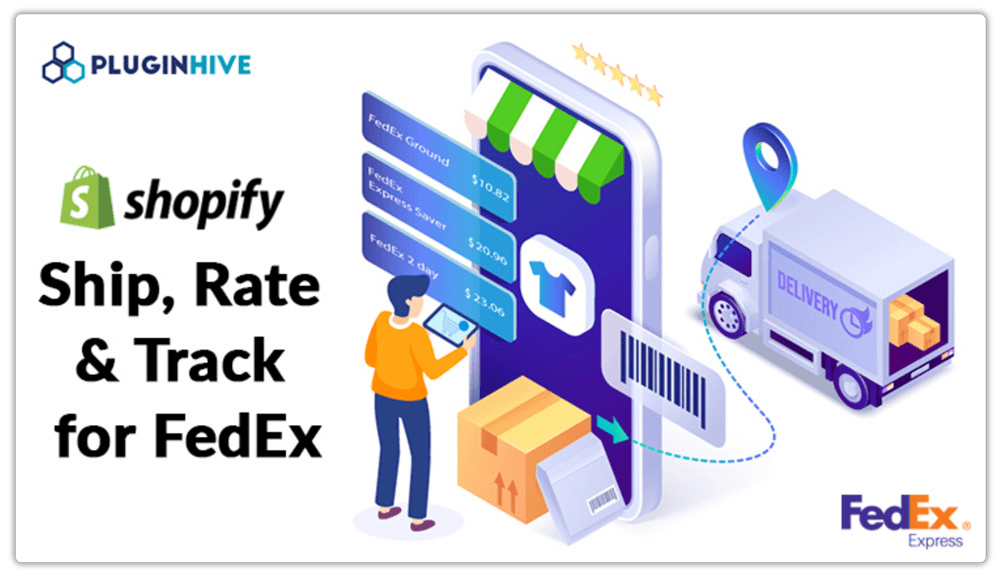
5. PH Ship Rate & Track for FedEx
Best for: Shopify merchants that ship exclusively with FedEx and want to automate live shipping rates, label generation, order fulfillment, and shipment tracking from a single, carrier-specific solution.
PH Ship Rate & Track for FedEx is a comprehensive FedEx shipping app that streamlines the entire fulfillment process within Shopify. It displays live FedEx shipping rates, including negotiated rates, at checkout, generates shipping labels in one click, automatically fulfills orders, and shares tracking details with customers. Supporting FedEx domestic, international, and freight services across 220+ countries, the app helps merchants deliver a faster and more accurate shipping experience.
Beyond label printing, the app includes advanced shipping automation features such as automatic package selection, commercial invoices, electronic trade documents (ETD), pickup scheduling, packing slips, manifests, delivery estimates, and bulk label printing. It also supports FedEx One Rate, Hold at Location, and a wide range of FedEx special services, making it suitable for businesses handling both domestic and cross-border shipments.
Its biggest advantage is its deep FedEx integration, allowing merchants to manage shipping, documentation, tracking, and fulfillment without leaving Shopify. Combined with responsive 24/5 email and on-call support, the app helps reduce manual work, improve shipping accuracy, and scale fulfillment operations as order volumes grow. The trade-off is scope: it is FedEx-only by design, so stores shipping across multiple carriers will still want a multi-carrier app like Shippo alongside it, while FedEx-committed merchants get deeper carrier-specific control than a generalist tool offers.
Pricing: Starts at $19/month, with plans available for higher shipping volumes and a 14-day free trial.
Job 2: Specialized Delivery Models (Local + Cross-Border)
6. Easyship — All in One Shipping
Best for: cross-border ecommerce stores shipping internationally that need Delivered Duty Paid (DDP) at checkout, HS code generation, and access to 550+ global courier services without opening individual carrier accounts.
Easyship holds strong ratings across the Shopify App Store and G2 and is the specialist pick for international shipping. The headline feature is Delivered Duty Paid (DDP) — Easyship calculates and displays the all-in landed cost at checkout (product + shipping + import duty + VAT + taxes) so the international customer sees their true total before paying. This prevents the "held at customs" refund spiral that kills international conversion when customers are surprised by a $50 duty bill on arrival.
Additional cross-border features: automatic HS code generation (the tariff classification codes customs requires for every international shipment), customs declaration automation across 550+ couriers, native integration with Royal Mail (added February 2026 for UK merchants), and pre-negotiated international shipping rates up to 91% off retail for high-volume lanes. The platform consolidates Shopify plus Amazon plus WooCommerce plus 10+ other channels into one dashboard — similar to Shippo/ShipStation but with the international focus.
Where it falls short: domestic US shipping is less competitive than Shippo on pricing — Easyship shines for merchants where 30%+ of orders are international. Less refined for label-printing workflows at high domestic volume. The dashboard can feel crowded during the first few weeks.
Pricing: Free plan available. Paid from approximately $23/mo Plus tier scaling with volume.
7. Zapiet — Pickup + Delivery
Best for: hybrid stores that run in-store pickup and local delivery alongside shipped orders — a workflow no label-printing app handles correctly.
Zapiet Pickup + Delivery holds 4.8 stars across 1,290+ reviews and is the purpose-built app for the hybrid workflow that breaks most generalist shipping apps. Core features: an in-store pickup date/time picker at checkout, local delivery zones with custom rate calculation, Square POS integration for unified online + in-person order management, route organization for delivery drivers (reducing fuel costs and delivery time), and calendar-based delivery scheduling for perishables or appointment-based services.
The use cases this solves: a local bakery selling online but offering same-day pickup at the storefront; a florist taking orders online with same-day local delivery plus standard shipping for out-of-area orders; a butcher shop running online ordering with scheduled pickup windows; a restaurant group selling meal kits with delivery to designated zip codes. All of these require date/time selection, zone-based rates, and often calendar blocking — none of which a general label-printing app handles.
The app is Online Store 2.0 theme-compatible and integrates cleanly with Shopify's checkout extensibility. Zapiet also offers sibling apps for specific rate scenarios: Rates by Distance (GPS-based delivery pricing), Rates by Zip Code (zone-based pricing), and Product Rates (per-product shipping rules).
Where it falls short: only solves the local pickup/delivery job — you still need a separate label-printing app for shipped orders. $29.99/mo entry price is higher than most of this list. Not useful for pure shipped-only stores.
Pricing: From $29.99/mo Starter. Higher tiers for multiple locations and advanced features.
Job 3: Checkout Rate Calculation (Complex Catalogs)
8. ShipperHQ
Best for: merchants with complex catalogs, multiple fulfillment locations, dimensional packing, in-store pickup, LTL freight requirements, or non-standard shipping rules that Shopify's native rate engine cannot handle.
ShipperHQ is not a label-printing app and should not be compared head-to-head with Shippo or ShipStation — it is the checkout rate calculation engine, solving a fundamentally different problem. Shopify's native shipping rules can charge a flat rate, a rate by weight, or call a carrier for live rates. That is it. For merchants selling furniture (dimensional packing matters), appliances (LTL freight), groceries (perishability zones), or any complex catalog with multi-warehouse fulfillment, Shopify's native rules break down fast.
ShipperHQ adds the missing logic layer: dimensional packing algorithms that calculate the optimal box size per cart (a cart with 3 small items versus 1 large item needs different box dimensions, which produces different rate quotes); rate rules that apply per SKU, cart total, destination zone, or customer group ("VIP customers get free 2-day shipping; oversized items add a $50 surcharge; Alaska and Hawaii are excluded from ground rates"); multiple fulfillment origin support with automatic warehouse selection based on customer location; LTL freight quoting from providers like XPO, Estes, and Old Dominion; and hybrid in-store pickup scheduling alongside shipped orders.
The pricing reflects the specialist positioning. Plans start at $75/mo with a 15-day free trial and enterprise plans negotiated directly. For a furniture store doing $100K/month, a 5% lift in shipping-cost accuracy (preventing overcharging customers or absorbing shipping losses) easily pays for the subscription.
Where it falls short: overkill for simple stores — a $75/mo rules engine is waste if you sell standard-size items that fit USPS flat-rate boxes. Does not print labels; you still need Shippo or ShipStation for backend fulfillment. Setup complexity is high; plan for a few hours of rule configuration minimum.
Pricing: 15-day free trial. Plans from $75/mo. Enterprise custom.
Job 4: Free-Shipping Merchandising (The Storefront Layer)
Everything above is backend or checkout infrastructure. This job is the one most shipping roundups skip entirely: telling the customer on the storefront what their free-shipping threshold is and actively pushing their cart total toward it before they reach checkout. Every dollar the bar moves a customer past the break-even is pure margin, because the shipping cost is the same either way. This is the single highest-leverage shipping optimization most stores ignore.
9. Libautech Announcement Bar
Best for: stores that want progressive free-shipping bars (real-time cart-total-aware messaging) AND static threshold bars ("Free shipping on orders over $50") running on the storefront — the missing merchandising layer on top of any label-printing app.
Libautech Announcement Bar holds 4.8 stars across 26 reviews and is Built for Shopify certified. The app is not a shipping tool — it is the storefront-messaging layer that communicates free-shipping thresholds and actively drives AOV toward them. Two core modes matter for this job:
Progressive free-shipping bar. Displays dynamic messaging that updates in real time as the customer adds items to cart. A customer with $38 in cart sees: "Add $12 more to unlock free shipping." When they add a $15 item, the bar immediately updates: "Congrats! You unlocked free shipping." This cart-aware messaging creates active behavioral pressure — the customer sees a specific dollar gap and is motivated to close it. Stores running progressive free-shipping bars typically see 10-20% AOV lifts once the threshold is set to approximately 15-25% above current average order value.
Simple static free-shipping bar. For merchants who prefer the cleaner "Free shipping on orders over $50" messaging at the top of every page without per-cart logic, the static bar mode is the right pick. This works well for stores where most orders already hover near the threshold or where the brand voice prefers calm informational messaging over dynamic urgency mechanics. Both modes are configurable in the same app — you do not need two apps to run progressive bars on some pages and static bars on others.
Additional features relevant to shipping stores: bar scheduling ("Free shipping this weekend only" auto-activates Saturday and deactivates Monday), geographic targeting (show "Free US shipping" only to US visitors, hide the bar for international), page targeting (show on homepage and collection pages, hide on checkout), countdown bars for promotional free-shipping windows, cart progress indicators for tiered thresholds ("Free shipping at $50, free gift at $100"), rotating bars for multi-message testing, and full customization of text, colors, placement, and buttons. All six bar types (announcement, free shipping, countdown, cart progress, rotating, scrollable) are available in the same app.
Concrete example: a beauty store selling $18-$32 items at $47 AOV configures the progressive free-shipping bar at a $60 threshold. Every visitor now sees "Add $X more to unlock free shipping" where X dynamically reflects their actual cart gap. Customers naturally add a second product to close the gap. AOV moves from $47 to approximately $56 in the first 30 days — a 19% lift — while free-shipping cost per order (roughly $8) is absorbed by the same order now averaging $9 more in product revenue. The bar pays for itself on day one.
The pairing angle with any shipping app on this list is clean. The label-printing app (Shippo, Shopify Shipping, ShipStation) handles the backend once the customer checks out. The rules engine (ShipperHQ) handles what rates show at checkout. Libautech Announcement Bar handles what the customer sees on the storefront before they reach checkout. All three layers operate independently and reinforce each other — the bar drives AOV up, the rules engine quotes the right rate, the label-printing app fulfills efficiently.
View Libautech Announcement Bar on the Shopify App Store →
Pricing: Free plan available. Pro $6.99/mo. Package plan $14.99/mo (includes all Libautech Premium apps). 7-day free trial on paid tiers.
Which App to Choose
For new US-based stores shipping under 50 orders/month domestically: Shopify Shipping (native). Already included, carrier discounts up to 88%, no extra setup. Upgrade when you hit multi-channel or automation needs.
For general-purpose label printing at any volume with the cleanest dashboard and best support reputation: Shippo. 4.8/825+, API on all plans, $19/mo Pro.
For high-volume multi-channel merchants (500+ orders/month across 3+ channels): ShipStation. Deepest marketplace integration (400+), sophisticated automation rules, $9.99/mo entry.
For shipping bundled with email marketing and inventory: ShippingEasy. $19.99/mo for three jobs in one app if you do not already run Klaviyo.
For FedEx-only stores wanting live rates, labels, and tracking in one carrier-specific app: PH Ship Rate & Track for FedEx. $19/mo, deep FedEx integration including One Rate and ETD, 14-day free trial.
For cross-border shipping with DDP and international compliance: Easyship. 550+ global carriers, HS code generator, landed-cost display at checkout.
For hybrid local pickup + delivery + shipped orders: Zapiet Pickup + Delivery. 4.8/1,290+, Square POS integration, purpose-built for the hybrid workflow.
For complex catalogs with dimensional packing, multi-warehouse fulfillment, or LTL freight: ShipperHQ. $75/mo checkout rules engine, not a label-printing app.
For free-shipping bars on the storefront (progressive + static): Libautech Announcement Bar. $6.99/mo, the merchandising layer that drives AOV toward your free-shipping threshold.
For most US-based Shopify stores doing $5K-50K/month in revenue, the honest stack recommendation is two apps: Shippo or Shopify Shipping for backend label printing, plus Libautech Announcement Bar for storefront free-shipping merchandising. That combined stack costs approximately $26/month ($19 Shippo + $6.99 Announcement Bar) and covers the two highest-leverage shipping jobs: efficient fulfillment and active AOV lift toward free-shipping thresholds. Stores with complex catalogs add ShipperHQ. Stores with heavy international volume swap Shippo for Easyship. Stores with local pickup add Zapiet. FedEx-committed stores use PH Ship Rate & Track for FedEx for deeper carrier-specific control.
How We Ranked These Apps
This ranking is based on four criteria applied to every Shopify shipping app tested in 2026. First, verified ratings and review volume across the Shopify App Store, G2, Capterra, and SoftwareAdvice as of April 22, 2026 — we triangulate across platforms because single-platform ratings can be skewed by review incentives. Second, which of the four shipping jobs the app actually solves (label printing, checkout rate calculation, specialized delivery, or free-shipping merchandising) rather than a generic feature checklist. Third, pricing structure and total cost at realistic merchant volumes — flat-rate versus per-order versus volume-tiered makes a meaningful difference at 100, 500, and 2,500 orders per month. Fourth, integration depth with Shopify Checkout Extensibility, multi-channel sales, and complementary apps (marketing, inventory, POS).
Every pricing figure in this post was verified directly from the live Shopify App Store listing or vendor website on April 22, 2026. Shipping-app pricing tiers change often — always confirm current pricing on the official listing before committing. Ratings reflect verified review counts at time of last update.
Frequently Asked Questions
What is the best Shopify shipping app in 2026?
The best depends on your volume, channels, and shipping profile. For general-purpose label printing on Shopify: Shippo at 4.8 stars across 825+ reviews with API access on every plan. For new US stores under 50 orders/month: the native Shopify Shipping already bundled with your subscription. For high-volume multi-channel: ShipStation. For FedEx-only stores: PH Ship Rate & Track for FedEx. For cross-border: Easyship. For local pickup + delivery: Zapiet. For complex rate rules: ShipperHQ. For free-shipping bars on the storefront (the layer most stores miss): Libautech Announcement Bar. Most stores run two apps — one for backend label printing, one for storefront free-shipping merchandising.
How do I set up free shipping on Shopify the right way?
Three mechanics work together. First, set a free-shipping threshold in Shopify Settings > Shipping and Delivery (e.g., "Free shipping on orders over $50"). Second, display the threshold on your storefront via a free-shipping bar — a static version ("Free shipping on orders over $50") communicates the threshold, a progressive version ("Add $12 more to unlock free shipping" that updates in real time) actively drives AOV toward it. Third, make sure the threshold is set approximately 15-25% above your current AOV so most orders cross it with one small addition. Libautech Announcement Bar handles both static and progressive modes.
What is a progressive free-shipping bar?
A progressive free-shipping bar is a storefront message that updates in real time as the customer adds items to their cart. A customer with $38 in cart sees: "Add $12 more to unlock free shipping." When they add a $15 item, the bar updates immediately: "Congrats! You unlocked free shipping." This creates active behavioral pressure toward the threshold, unlike a static bar that just states the threshold once. Stores running progressive bars typically see 10-20% AOV lifts within 30 days, with the uplift depending heavily on how far the threshold sits above current AOV.
Does Shopify's native shipping work for small stores?
For US-based stores shipping under 50 orders per month domestically with no multi-channel needs, yes. Shopify Shipping is included with your subscription, offers USPS/FedEx/UPS/DHL rates with discounts up to 88% off retail, and prints labels directly from admin. Once you add Amazon, Etsy, or eBay as selling channels, or need automation rules (auto-assign carriers based on weight or destination), upgrade to Shippo or ShipStation for proper multi-channel workflow.
What is the difference between Shippo and ShipStation?
Shippo has a cleaner dashboard, better support reputation (4.8/825+ vs ShipStation's ~4.0/700+), API access on every plan tier, and is simpler to set up — generally the right pick for Shopify-focused stores under 500 orders/month. ShipStation has deeper marketplace integration (400+ channels vs Shippo's ~20), more sophisticated automation rules, and scales better to 2,500+ orders/month across multiple sales channels. Above 500 orders/month with 3+ channels, ShipStation's automation typically wins despite the support reputation; below that, Shippo is simpler and better-rated.
How much does shipping software cost for a Shopify store?
Entry tiers range from free (Shopify Shipping native, Shippo up to 30 labels, ShipStation up to 50 orders) to $19-20/mo (Shippo Pro, ShippingEasy Growth, PH Ship Rate & Track for FedEx) to $75/mo for specialist checkout rules (ShipperHQ). Free-shipping merchandising (Libautech Announcement Bar) adds $6.99/mo. A typical small-to-mid Shopify store running Shippo + Announcement Bar pays approximately $26/month total for the full stack. Cross-border stores running Easyship scale with volume to $50-200/mo. High-volume multi-channel on ShipStation scales to $99-299/mo.
What is Delivered Duty Paid (DDP) and why does it matter for international shipping?
Delivered Duty Paid means the merchant collects all landed costs at checkout — product price + shipping + import duty + VAT + taxes — so the international customer pays everything up front and receives their package with no surprise fees at customs. Without DDP, customers often get hit with surprise duty bills on delivery and refuse the package, triggering costly return shipments and chargebacks. Easyship's DDP feature at checkout is the specific solution and significantly reduces international cart abandonment. ShipperHQ also supports DDP for complex international rate scenarios.
Do I need a shipping app if I use Shopify Shipping?
For storefront free-shipping merchandising, yes — Shopify Shipping handles backend label printing but does not touch how free-shipping thresholds are communicated on your storefront. A progressive or static free-shipping bar (Libautech Announcement Bar, $6.99/mo) is a separate layer that drives AOV toward your threshold before checkout. For most stores the answer is Shopify Shipping (or Shippo) for labels plus Announcement Bar for merchandising — not either/or.
What is the difference between a shipping rate app and a label printing app?
Rate apps (ShipperHQ, Intuitive Shipping, Advanced Shipping Rules) control what shipping options and prices the customer sees at checkout based on cart contents, destination, weight, dimensions, and rules. Label apps (Shippo, ShipStation, Easyship, PH Ship Rate & Track for FedEx) handle the backend workflow after checkout — printing labels, comparing carrier rates for the actual shipment, and updating tracking. Simple stores use only a label app and rely on Shopify's native checkout rate calculation. Complex catalogs with dimensional packing, oversized items, or multi-warehouse fulfillment need both a rate app and a label app — they solve different jobs.
Will shipping apps slow down my Shopify store?
Label-printing apps (Shippo, ShipStation, Easyship) run entirely in the merchant admin and have zero storefront impact — customers never see them. Checkout rate engines (ShipperHQ) add one API call at checkout rate calculation, which typically adds 200-500ms to the rate-fetching step and is acceptable. Free-shipping bars from Built for Shopify apps (Libautech Announcement Bar) load asynchronously with no impact on Core Web Vitals or Lighthouse scores. Storefront performance is generally not affected by any app on this list.
Think Your App Belongs on This List?
We update these lists as new tools launch and existing ones improve. If you are a developer building a Shopify shipping app and want your app considered for inclusion, submit it here — tell us what your app does, who it is for, and include a link to your Shopify App Store listing. We review every submission.